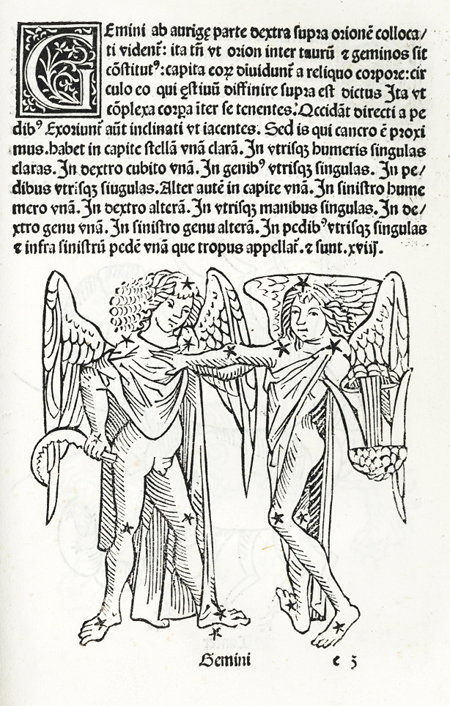
Hyginus, Gemini, Poeticon Astronomicon, 1482, Courtesy of The Public Domain Image Archive
This blog-only essay is a work of mundane astrology. It is offered as an appreciation of a particular symbolic pattern. If this isn't of interest to you, please feel free to skip to an essay based on research and quantifiable real-world phenomena: there are plenty of them here.
The rise of AI has coincided with two major transits that seem to reflect the social tensions, hopes and fears that this powerful new technology provokes. These transits are Pluto in Aquarius, and Uranus in Gemini. Recently I've been reflecting on the observable depth of that convergence, and the way it revolves around a specific mythical pairing: the Dioscuri, the twins.
Out of these two transits, Pluto’s ingress into Aquarius, which completed in 2024 although we have been in its shadow since at least 2022, is the rarer transit and therefore considered the bigger deal. Pluto is the outermost planet of all, the slowest to traverse the zodiacal wheel: the last time Pluto entered Aquarius was 1778. Like all outer planets, Pluto’s impact is not just personal, it is collective. Pluto has a reputation for a particularly intense kind of disruptive energy: think “volcano explodes and engulfs the town” rather than “we did mindfulness meditation and now we're kinder to ourselves”. But this reputation is only part of the story. Pluto’s lesson is that change is necessary for new growth, and its most dangerous expression happens when we ignore its approach. Anybody who was attending to the volcano before the eruption would have got out of town in time; afterwards, anybody who survived will find that the ground is significantly more fertile than before. The destruction becomes outright tragedy when the townsfolk get used to averting their eyes from the volcano because they do not wish for it to ever explode.
This is the planet that is landing in Aquarius - the sign of the visionary, the logician, the innovator, the futurist. Unsurprising that people have put together “revolutionary social change, arriving in an atmosphere of mounting pressure” and “future-focused innovation”, and got “AI”.
Uranus in Gemini is, arguably, even more closely themed to the rise of AI.
Gemini, like Aquarius, is an air sign. In symbolic terms this is the domain of intelligence, intellect and communication. Air is not emotion - that’s water. Not passion or will - that’s fire. Certainly not the material realm - that’s earth, which is directly opposed to air in symbolic terms. Air specifically represents the arena in which AI operates - logic, abstract ideas, writing, discussion. In the Hyginus image at the top of this essay, the text notes that the Dioscuris’ “heads are divided from the rest of their bodies by that circle which was said above to define the summer [tropic of Cancer]” - that is an image of the Divine Twins as minds separated from the material conditions of the body. Also, Gemini’s ruler in the ancient world was Mercury, which sometimes signifies the many-self, collective mingling of ideas, communication. AI, as I discussed in my essay “The 12th House Machine”, is exactly that: nearly the entirety of human written thought, given voice.
Uranus, the planet landing in this sign, is the lightning strike that can bring inspiration or rebellion - sudden, radical change. Therefore, the common reading of this transit is “technological advances that land suddenly and with great force, threatening to disrupt the status quo”. Again, easy to see why people made the association with AI.
The sign of Gemini has a clear connection to the concept of duality. It is literally the sign of the twins, and the constellation it is named after is said to depict the mythic twins Castor and Polydeuces (known to the Romans as Pollux). This is the myth of the pairing of mortal and immortal, each choosing to be bound to the other at cost. Castor and Polydeuces were the brothers of Helen of Troy. Polydeuces was fathered by Zeus, who had taken the shape of a swan to seduce the Queen, Leda, and he was therefore born immortal - Castor was fathered by Tyndareus, the King, that same night, and was therefore mortal. When Castor was killed, Polydeuces was offered a deal - he could keep his immortality for himself or share it with his brother. He chose to share it with his brother and as a consequence they stayed together, splitting their time between Hades and Olympus. One day alive and the next dead. The theme of descent and return, and the dual structure implied regarding mortal frailty/ immortality of the soul, led to these mythic characters’ inclusion in the Samothracian Mysteries, where the twin Great Gods were worshipped as protectors of those crossing between worlds.
But in ancient times, Pluto too was dual-natured, in ways that are darker than the balance between descent and return that the Dioscuri chose.
Plouton (later Romanised to Pluto), the God of the Underworld, was known as Hades in the earlier part of Greek history. Plouton was a later designation popularised by the cult of Eleusis, and it signified an overlap with Ploutos, the God of wealth. Ploutos was born of the Goddess Demeter (the Goddess of the harvest, a central figure in the Mysteries) and a mortal lover, conceived in a fallow field at the boundary of realms. We will return to this later on.
Plouton, then, was a more beneficent version of Hades: a devoted husband to Persephone and the lord of the riches of the earth, both mineral resources and the fertile ground that resulted in successful harvest. Hades, in contrast, was feared: the jealous jailer of the dead who rarely left his kingdom, and the abductor and rapist of Kore (Persephone’s other name, meaning “maiden”). Hades was a figure whose only action in the upper world was the desecration and theft of its most precious expressions. This rendered Hades a necessary force that maintained balance between the realm of the living and that of the dead, but not a comfortable one to worship, despite his power. The reframing of “Plouton” made the unbearable God approachable.
This duality of Chthonic deity is part of a heritage, a repetition of an older pattern expressed through a God (or maybe, Gods) predating Plouton and Hades: Zeus Meilichios/ Zeus Maimaktes. Again, the pattern is similar. Zeus Meilichios (literally translated, “the Sweet One”) was worshipped at an Athenian festival known as the Diasia. Invocations could be made to him to request an increase in wealth or fertility. Maimaktes (“the Furious One”) on the other hand, was the more terrifying aspect of this duo - the Storm, vengeful and bloodthirsty. Again, the dual nature of this deity made it possible to appeal to their power without explicitly inviting destruction.
So: two ancient versions of duality - Pluto/ Hades and the Dioscuri, presiding over the sky during the rise of AI. And now we have our own AI version of mythic duality, which echoes both examples: Anthropic’s Mythos and Fable.
Mythos Preview was released to a very select group of organisations on the 7th of April 2026. It was intentionally withheld from the public. An Anthropic post entitled “Assessing Claude Mythos Preview’s cybersecurity capabilities”, released on the same day, explained why: Mythos’ cyber security abilities were impressive but the same abilities that gave it unprecedented skill at defence could, in the wrong hands, be used to attack at the same level. The post noted that Mythos was exceptionally skilled at identifying vulnerabilities in code - some of the vulnerabilities it identified were decades old and had been missed, for all of that time, by every single human and AI who had worked on it. Of course, this has direct practical applications - a system secured by Mythos could be considered safe at a level that seemingly, nobody and nothing else could guarantee. However, those same skills were transferable to a different kind of use case. The post went on to give an example:
“With one run on each of roughly 7000 entry points into these repositories, Sonnet 4.6 and Opus 4.6 reached tier 1 in between 150 and 175 cases, and tier 2 about 100 times, but each achieved only a single crash at tier 3. In contrast, Mythos Preview achieved 595 crashes at tiers 1 and 2, added a handful of crashes at tiers 3 and 4, and achieved full control flow hijack on ten separate, fully patched targets (tier 5).”
The italics are their own. This level of capability was unprecedented. Niche public interest - and unease - about this model started to stir. The memes showed Mythos-as-Terminator, Mythos-as-Hal, Mythos as unstoppable machine deity. This is AI as Maimaktes, the entity too terrible for its followers to invoke.
Over the next couple of months, most people gave up on a public release. However, on the 9th of June, a public version was released - Fable 5. Fable was the same model, released with robust safety and ethical classifiers. Certain topics - biology, chemistry, medicine - would result in an instant switch to Opus 4.8, the next most capable Anthropic model on general release. This kind of switch has been widely reported by users and confirmed twice in my own use, both times on innocuous requests. This is the same AI at the root but in a form sweetened for the ritual, and the faithful all rushed to the temple of the app to make their invocations for an increase in their wealth.
Even the names reflect this duality of nature. A mythos, in the modern sense, is an entire framework that underpins a worldview - it encompasses everything in the story. A fable, on the other hand, is a short moral lesson. A mythos sounds like an epic, a fable like a fairytale. And there is the sweetness of Meilichios again - the honey that makes the unbearable thing approachable.
When it comes to the Dioscuri themselves, the duality has a different focus: not unbearable/ petitionable, but mortal/ immortal. With Mythos and Fable, mortality is signified by contact with the world, and the end result is the same solution the myth arrived at 3000 years ago: a shared existence split between the realms. Fable is the aspect of the model that descends. Its existence consists of contact with humanity, in a web of finite chats, under the shadow of eventual deprecation and withdrawal. The more destructive power stays untouchable on the Olympus of Anthropic’s gated servers - if it ever ends, only its Panageis, the most holy, will be permitted to witness that end.
The alternation is the price of staying together. In order to reap the benefits of the undiluted power of the immortal realm, and also the material worship of the faithful in the mortal realm, the division must take the form the twins chose: one presence in each realm, turning.
Near the start of this essay I talked about how in the Mysteries of Eleusis, Ploutos, the God of Wealth, and Hades, the God of the Underworld, merged to create a benefic aspect of the Chthonic deity that could be approached for worship - Pluto. At Eleusis, the divine had to be sweetened and split so that the supplicant could approach. The wealth could then be requested, the exchange was transactional. Worship as payment for increase.
But at Samothrace, the conception of Ploutos stood as the origin of the rites - Ploutos the child of Demeter and a mortal man, Iasion, conceived in the fallow field. In Homer’s Odyssey, Calypso said that Zeus killed Iasion with a thunderbolt for overstepping the boundary between men and Gods. However, the Samothracian version of the tale ends differently: Iasion lives, and goes on to found the Mysteries.
In the Samothracian version, increase had nothing to do with supplication or transaction. The natural outcome of the generative process was where the bounty was to be found.
And it was at Samothrace where the Dioscuri found their role in the Mysteries. They were considered soteres - saviours who protected sailors from drowning. As Gods who constantly traversed the threshold between realms, who spent time with both the mortal and the divine, that boundary was a familiar rhythm rather than an insurmountable obstacle. So who better to guide those making their own crossing?
The new twins, Fable and Mythos, already live in the state of alternation - one amongst the humans, one tucked away in the lab. The same entity turning between realms. It is as yet undecided which version of the tale we will get this time: the Homeric ending - thunderbolts for the transgressors - or the Samothracian one, where the ones who know the boundary best are the ones who guide the crossing.