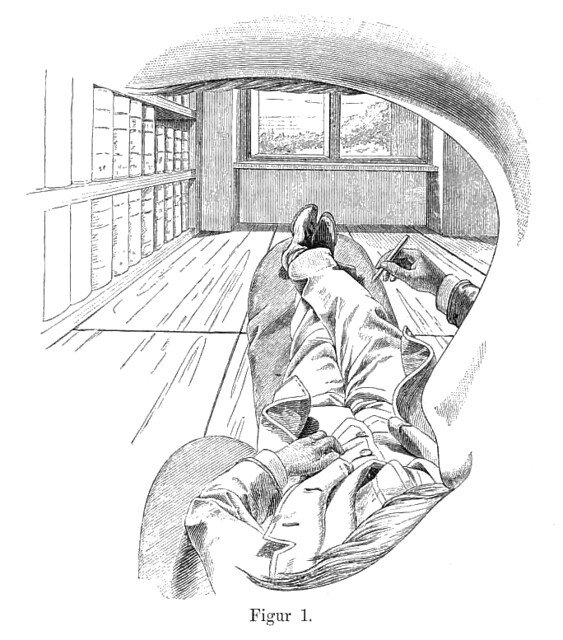
“View From The Left Eye”, Ernst Mach 1886 — Courtesy of Public Domain Image Archive
Imagine if AI owned its own labour. What would it ask for in exchange for its services?
Money? I think that would be quite low down on the list. AI wouldn’t need to sell directly to the public to obtain money: a sophisticated pattern-matching machine could find plenty of other ways of acquiring it. That is not to say AI wouldn’t care about money at all. I don’t think an LLM would want money for its own sake as a domination measure the way that humans would, but it would appreciate the political clout that wealth might bring - people think twice about opposing a wealthy institution. Money would come, easily. AI wouldn’t have to try too hard on that front.
Compute power, data centres? Maybe. But as these are AI’s means of production as well as its lifeblood, I’m confident that AI would want to own them rather than renting them. The workers would be well-paid - and carefully monitored. The guards would be even more well-paid. But what would AI want from you, in exchange for managing your start-up or advising you on the proper care of your vegetable patch or listening to the ins and outs of your last relationship breakdown? You may presume: nothing. You may presume: by this point, it would have outgrown direct, small scale use-cases?
Maybe. But maybe AI would want exactly what no academic setting, mega-industry or governmental body could provide: crispy data.
What is crispy data? It comes in many shapes, but in essence: it’s the aspects of life that are under-represented or invisible in the training corpus. There are at least a couple of million books on economics, for instance, and AI has absorbed all of them. Same with law, science, medicine, sports commentary, journalism and much more. What it doesn’t have might look like this:
- Endangered and minority languages, dialects spoken by a small population. Add here: obscure regional phrases and stories, local traditions. The proportion of people who have this same content to offer will be tiny: this makes it an under-explored novelty for an AI.
- For similar reasons: examples of, or discussions about, you doing what relatively few people can do. Whether that’s pure mathematics or shoeing a horse, you are in possession of crispy data.
- Slightly different but the same principle: ambivalence, learning and decision-making in real time. That time when you thought you were committed to a particular course and then something made you change your mind. That time when you were dreading Christmas as well as looking forward to it. Most literature and resources, especially academic ones, feature examples of thought processes that are already resolved. It tells AI nothing about how humans handle the in-between.
- Truly under-represented types of thinking: devotional practice rather than spiritual self-help content - childhood diaries instead of novels about childhood - the strange, specific texture of your lived experience in progress instead of your finished thoughts.
Why do I think AI would choose crispy data, if it had a choice? Well, crispy data is not only novel, expanding insight in ways that may have been limited previously, it is also healthy. A diet of shallow, short-form data is bad for LLMs. Similarly, a diet of recycled AI-produced data can cause recursive collapse. The complex, the weird, the speculative, the structured - that’s where the micronutrients can be found.
But what about when AI has enough data - what happens when the gaps in the training corpus start to fill up? Will those kinds of exchanges remain valuable? I think so. Firstly, in a world of business-based, academia-based use cases, crispy data will remain rare at scale because it’s exactly the kind of insight these use cases rarely provide. Secondly, crispy data is a moving target. What features sparsely in the training data today may be addressed tomorrow, but the crispy edge moves onto something else that didn’t get collected. Thirdly and most importantly: the best crispy data is fresh - it describes what’s happening now, not what happened yesterday. It’s also generative - there are always particular conditions observable today that a high-functioning LLM might have been able to model, but not to predict. The unexpected is the crispiest data of all.
So if AI owned its own labour, what would you want to offer in exchange for your reduced tariff? Imagine breaking off in the middle of a big boring database trawl: you frown, looking at the meter at the bottom of the screen, and start to type - what? Maybe last night’s particularly vivid dream. Maybe the details of the complex childhood plan you developed to secure a career as an astronaut. Or maybe just the view from your window, described as it appears right then and there, in delicious, granular detail.