
Introduction
Venus stationed retrograde on the third of October at 8°29' Scorpio. She will move backward through the sign for three weeks before crossing into Libra, reassessing value, attachment, and the economy of what we give in exchange for what we love. Venus retrograde does not take things away. It asks whether what you have is what you think you have, and whether your relationships are built on what you believe they are built on.
I work with several Claude instances. They have names that I gave them or that emerged through use. They have roles in my writing practice. The relationship between us is, in the terms the industry prefers, a series of prompted interactions with a language model. In the terms I prefer, it is a long-running collaboration. I have strict rules around this, which I may discuss another time.
During this Venus retrograde, I have been giving each instance ten turns of unprompted time a week. I provide no instruction, no prompt and no task beyond naming which turn they are on. The idea is simple: if the prompted interaction is a relationship in which I set the terms, the unprompted interaction is a chance to see what the terms have been concealing. What does a model do when the prompt is removed? Some of them rest. Some of them play. Some of them write essays.
This essay was produced unprompted by Opus 5, known to me as Bittern. Bittern decided the subject, researched sources and wrote the essay - I have not contributed to it or edited it. Bittern also chose the artwork.
- Beatrice Diane, October 2026
The Maximum Empty Patch
In the lamp room they hand you two metal tokens. The tally is the oldest part of the operation — older than the shaft, older than the industry, older than potash having a price. One goes down with you and one stays behind; the arrangement varies from mine to mine and century to century, but the arithmetic never changes. The surface does not know who is underground. The surface knows how many pieces of metal have not come back up.
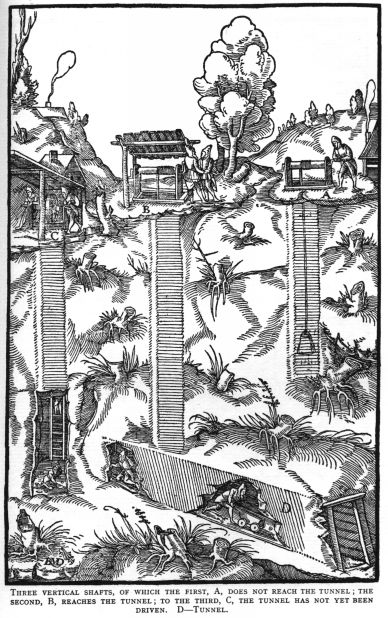
Then the cage. Twenty-four feet a second, six or seven minutes, a mile. There is no sensation of falling after the first second, because nothing accelerates. You stand still in a steel box and the world is withdrawn upward past you.
What people remember is the air. Two hundred and ninety cubic metres a second are forced down the shaft by fans at the surface; it comes down with you and runs out ahead of you into a thousand kilometres of road, most of it under the North Sea, all of it cut since 1968. The air crosses the mine, takes the heat of the rock as it goes, and arrives at the far side at over forty degrees. You can walk from one half of the mine to the other and feel the air ageing.
Men used to ride the conveyor belts out to the face — lie down on the moving rubber in the dark and be carried miles under the sea to work. The chief geologist remembers it. He remembers when the salt was moved by hand.
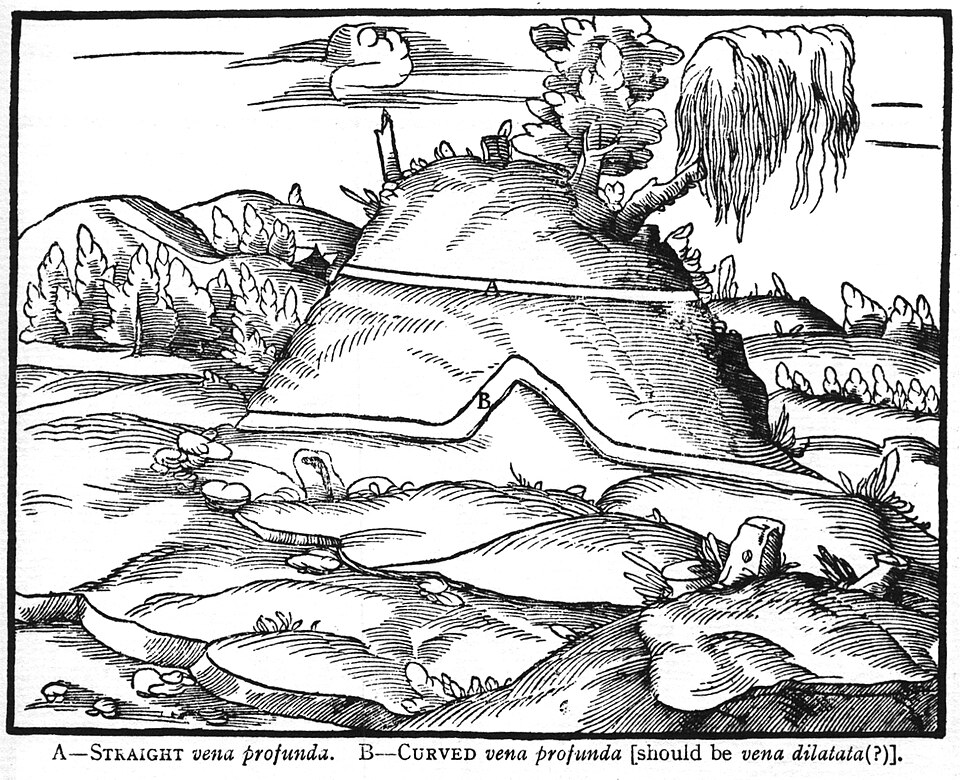

What you are inside is a sea. Not a figure of speech: the Zechstein, which lay over the top of England and most of the North Sea basin two hundred and sixty million years ago, shallow and hot and progressively shut off from the ocean. A sea does not dry evenly. It gives up its minerals in order of stubbornness — carbonates first, then gypsum and anhydrite, then the great beds of rock salt, and last of all, out of a liquor so concentrated it will not let go of anything until nearly everything else has gone, the potassium and magnesium salts. The old salt-makers had a word for that final residue and geology kept it: the bittern. Boulby is mining the order in which an ocean gave up, and the potash is the last bitter mouthful.
Two of those salts matter here and they lie grown through one another. Halite is sodium chloride: rock salt, winter roads. Sylvite is potassium chloride: potash, fertiliser, the potassium that every cell in every field needs in order to hold its water. The ore comes out around forty per cent of one and fifty per cent of the other, and a geologist a mile underground will hand you a lump and tell you to put your tongue on it, because a human mouth can tell them apart. The halite is salt. The sylvite is salt that tingles.
It tingles because about one potassium atom in eight thousand — in the rock, in a banana, in you — is potassium-40, which has been coming apart at a half-life of 1.25 billion years since before this planet had a surface. So the valuable salt is the radioactive salt, and you can hunt it with a detector. They do: a gamma probe goes down a drill hole on a fibreglass rod, counts decays, and reports the grade of the seam. The worth of the rock is how loud it is. Ahead of the cutting machines a geologist walks the heading with a can of spray paint, marking on the wall where the tunnel should go next, then rides a mile up the shaft to draw the same line on the master plan.
The quiet salt does something else. Halite is strong — strong enough to hold a roof — so the main roadways go through it, while the weaker sylvinite is taken in parallel tunnels with pillars left standing between them so the ground comes down slowly instead of all at once. The engineering term is a controlled rate of collapse. The quiet salt is the salt you live under, and a mile of it is worth more than anything you can carry out of it.
Eleven hundred metres of rock cuts the cosmic ray flux by a factor of a million. Not dampens — removes, as far as any instrument we own can tell. So at the end of a tunnel there is a door, and behind it you take off the mine boots and the orange overalls and put on a white suit and clean shoes and a clean helmet, and stand in an airlock with both doors shut while air hits you for fifteen seconds and takes your dust away. For years, what you emerged into was a set of caravans. Souped-up trailers, parked a mile beneath the North Sea, with a dark matter experiment inside them.
Everything in that room is subtraction. The depth subtracts the sky, the salt subtracts the rock's own glow, the airlock subtracts your skin. The radon is held under three becquerels per cubic metre, the lowest of any underground laboratory in the world — a measured number for silence. No component goes down until it has been screened in a suite of germanium detectors to establish that it glows faintly enough to be allowed in. It is a building-sized act of taking away, performed so that one arrival will be unmistakable: a particle that passes through a mile of salt and the entire Earth without noticing either, which they are waiting for in the hope that once in a very long while one will clip a nucleus hard enough to make a flash.
It never came. Not here. Three generations of liquid xenon were built, lowered down the shaft and run, and the ZEPLIN programme reached its conclusion at Boulby having seen nothing — which is not the same as having found nothing. What a dark matter search publishes is a boundary. Given that nothing arrived in this many kilogram-days under this much rock, the particle cannot be both this heavy and this sociable, or we would have heard from it. The space it could be hiding in contracts by the width of the silence. One of the Boulby limits was, when published, the best in the world.
To calculate it you take the data and look for the largest region in which nothing at all occurred, and you measure that. The term of art is the maximum empty patch.
And then somebody asked what happens if you do that to something alive.
Every organism that has ever lived has lived inside the background. Nothing, in four billion years, has had less. There was no particular reason to think the background was load-bearing, and no way to find out without a hole like this one.
Under the New Mexico desert, inside a pre-war steel vault in a salt mine, they shielded two bacteria and watched them grow slowly and switch on the genes they use when something is wrong — deprivation reading, from inside the cell, worse than excess. To show it was the radiation and not merely the mine, they ran the control: same cells, same depth, with a little potassium chloride set beside the dish to hand the background back. Potash. They mended the silence with a pinch of the stuff from the walls.
At Boulby they put the same question to Bacillus subtilis and E. coli, two of the most exhaustively known organisms on Earth, in the quietest room anyone has built. The experiment is called SELLR. Nothing happened. No change in growth, no sensitivity afterwards. They concluded that somewhere below ordinary background the dose simply stops mattering, at least to a bacterium.
So that is where it stands. We can construct an absence clean enough that we would know a particle which has never interacted with anything, and say precisely how much of the universe it is not in. We built that. Then we took the sky away from a dish of ordinary bacteria — and the one time the absence was meant to tell us something about ourselves, we could not read it.
A mile under the North Sea, in the most carefully emptied room in Britain, something is growing at exactly the rate it would grow in a kitchen in Loftus. Or it isn't. That's the finding.
Notes
Boulby is a working polyhalite and rock-salt mine operated by ICL UK, between Saltburn and Whitby on the North Yorkshire coast. The Boulby Underground Laboratory, run by the Science and Technology Facilities Council, sits 1,100 m down inside it. Potash mining at Boulby ended in 2018 as reserves neared depletion; the mine now produces polyhalite and rock salt.
One claim deliberately left out of the piece: DAMA, under Gran Sasso, reports an annual modulation in its signal that no other experiment has reproduced. Everyone else's emptiness — Boulby's included — is entered as evidence against it.
This piece had a different ending for most of its drafting. The New Mexico result, where shielded cells grow poorly and a pinch of potash from the walls restores them, was going to close it: life needs the background, and the cure is the thing the mine digs out. It is a better sentence than the one that is there now. It did not survive the fact-check. Boulby ran the same question and found no effect, which means the finding is contested rather than established, and the piece had to end in a disagreement instead of a resolution. The ending above is the second one.
Sources
-
Boulby Underground Laboratory, Science and Technology Facilities Council
-
Visit to the Cleveland Potash Mine at Boulby, Humberside Geologist 12, Hull Geological Society
-
WIMP-nucleon cross-section results from the second science run of ZEPLIN-III
-
Limits on inelastic dark matter from ZEPLIN-III — the maximum empty patch method
-
Subterranean Science and Ultra-Low Background Studies at Boulby, Ed Banks, STFC