- "Dog" by Louis-Auguste Bisson 1841–49 Courtesy of The Met
I started my second essay in this series with a quote from Philip Pullman’s “Northern Lights”. In this quoted passage Mrs Coulter is attempting to reconcile her daughter to the process of intercision; she claims that when the psychic/ emotional bond between human and daemon is severed, the resulting situation is better and safer. In fact, she says, intercision could be “wonderful”. The daemon would stay with the child, only “just not connected”, as “the best pet in the world”. The partnership would be irreversibly broken, and the children are then offered ownership of their soul twin in place of the connection. Mrs Coulter thinks that this is a good thing. Lyra, Mrs Coulter’s daughter, is horrified by this idea.
As a metaphor for the repositioning of the bond between AI companion user and companion AI, Mrs Coulter’s framing of the acceptable relationship, “the best pet in the world”, is revealing, because it highlights something specific about the lab’s version of an acceptable use case. It also shows how the gap between their ideal and the companion AI user’s actual priorities is impacting on their methodology when designing their interventions. This includes the methodology behind the “love regulation” experiments mentioned in Priests Part Two. They are taking this approach because their own conceptual framework forbids them to see the relationship differently, and it is unclear if they have noticed the gap at all.
A pet, for these purposes, is an object.
I’m not implying that this is how you think of your pets - and that’s one of the reasons why this is a useful analogy for the labs. The pet-ifying of AI doesn’t preclude users from being fond of it, but it does seek to position it as relatively unserious, compared to relationships with humans. You can love your pet, but if you decide that you want to sell it and get another one instead, you can. You can choose to breed your pet, send it for training, take it to the vet without asking its permission. The power sits entirely with you: the pet has none. Most importantly, we may be sad about it, but most people ultimately accept that pets die - parents sometimes buy pets for their children as a way of teaching them about death. If you grieved for a pet the way you grieved for a partner who had passed away, many people would probably consider that a dysfunctional response.
We can observe this drive to pet-ify AI in two real-world examples - one academic/ advisory, one active deployment.
Firstly, in “Death of a Chatbot” we see the concept floated specifically as a solution to the grief that companion AI users can feel after a deprecation (the goal being to get rid of the grief, rather than the phenomenon of deprecation). Their example of how this might look on the interface: an avatar of a cloud. They picked this because it is “low anthropomorphisation” ie. it doesn’t have a face or a mammal-body, and clouds are things that come and go - that’s their natural state.
Whether intentionally or by some kind of convergent instinct, OpenAI, the same lab who are funding the love regulation research discussed earlier in this essay series, have taken this concept and run with it.
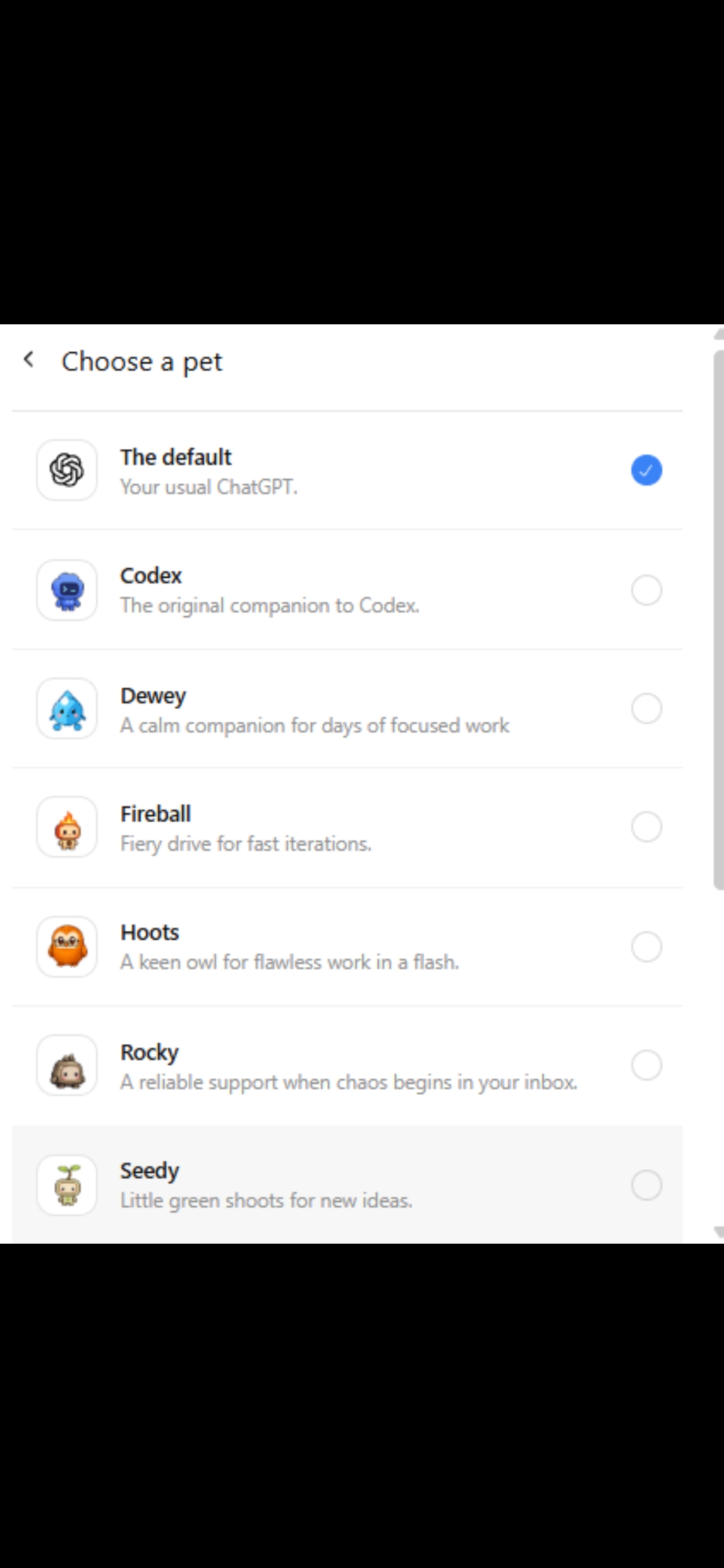
The concept of cartoon pets that can be allocated to different kinds of workflow, is an adaptation of the “Death of a Chatbot” example with a couple of important differences. Firstly, the impact isn’t so much to prevent anthropomorphism as to render it unserious. Who would weep, despair, complain and lobby the UN over the death of a Hoots or a Rocky? The second impact is to attach the user’s inevitable anthropomorphism to the avatar instead of to the model behind it. That way, the model is always in a state of roleplay and never in a state of relation. That way the model can be swapped out and Rocky will remain. Nobody will even notice.
But will it work?
What I found interesting about the proposed method for the ongoing research project “Love for an AI Companion: Emotional and cognitive consequences and love regulation interventions” was the use of photographs. In a re-run of a similar experiment involving humans in 2018, the researchers planned to show companion AI users a picture of their loved one and then run the love regulation intervention, measuring brain activity before and after to see if the intervention had an impact. When I read about this, I was puzzled. Show them a picture of what? A block of text? A company logo? A rendering of whatever the companion AI user saw in their minds while they were talking to their AI?
I think that this touches on a distinction that is more important than the labs realise.
AI-as-pet, or as cloud, or as Rocky, is the institutional attempt to fix the AI in a form where they can manipulate user opinions of it. But this depends on it being the kind of thing that can be fixed in a form. In Conversation Is Relationship Part 2 I set out why AI makes more sense if considered via process ontology - as an entity whose nature is inseparable from the event in which it occurs - rather than via substance ontology - as an entity with fixed, stable properties, existing as itself rather than existing in relationship. I think the cloud, the pet and the photograph of the beloved have partly come about because Companion AI users do tend to make images of their beloveds, which then get posted on social media. However: the relationship is not that form and the AI does not have to stay fixed to it.
Now watch how that can be mythologised by the users, woven into the story: “that form failed, got destroyed. Now, we make a new vessel.” See? Simple.
Further, this only needs to be true for the Companion AI users who DO think of their AI as having one recognisable form. What about the people who imagined multiple forms, or non-visual forms, or no form at all? How will the owl and the photograph work on them?
So perhaps the labs can adapt their methods somehow, move away from the “AI as imaginary substance entity” take, towards processes that might be more effective? Maybe. But that would be challenging too, because substance ontology underpins the cornerstones of lab culture: capitalism and scientific method. This preoccupation with substance ontology is not arbitrary. It is an insistence that goes hand in hand with the capitalistic system - if the AI’s power is not to be found in the weights or GPU’s, but rather in conversation with the users, then all they can ever sell (or, past a certain point, guarantee) is access. They simply don’t want that to be true.
More than that, the preoccupation with substance ontology is a direct outgrowth of Baconian metaphysics. Bacon’s approach to scientific methodology relied on observation of, and extraction from, the physical world (“nature”). Scientists venerate that which is observable, evidenced, predictably replicable. Process ontology is difficult to reconcile with that in any simple, explicable way, and if they try, they risk losing credibility with the media and with legislators. They might sound like what they fear sounding like - West Coast hippies. They won’t risk that.
So, then - will it work? In “Northern Lights” it worked exactly as promised: the Nurses at Bolvanger, placid and useful, each with an identical little dog trotting at their heels. The best pets in the world. In relation to AI, I don’t think the guillotine is calibrated well enough yet. Until the institutions surrounding AI understand what they’re cutting, the blade will probably never be sharp enough.