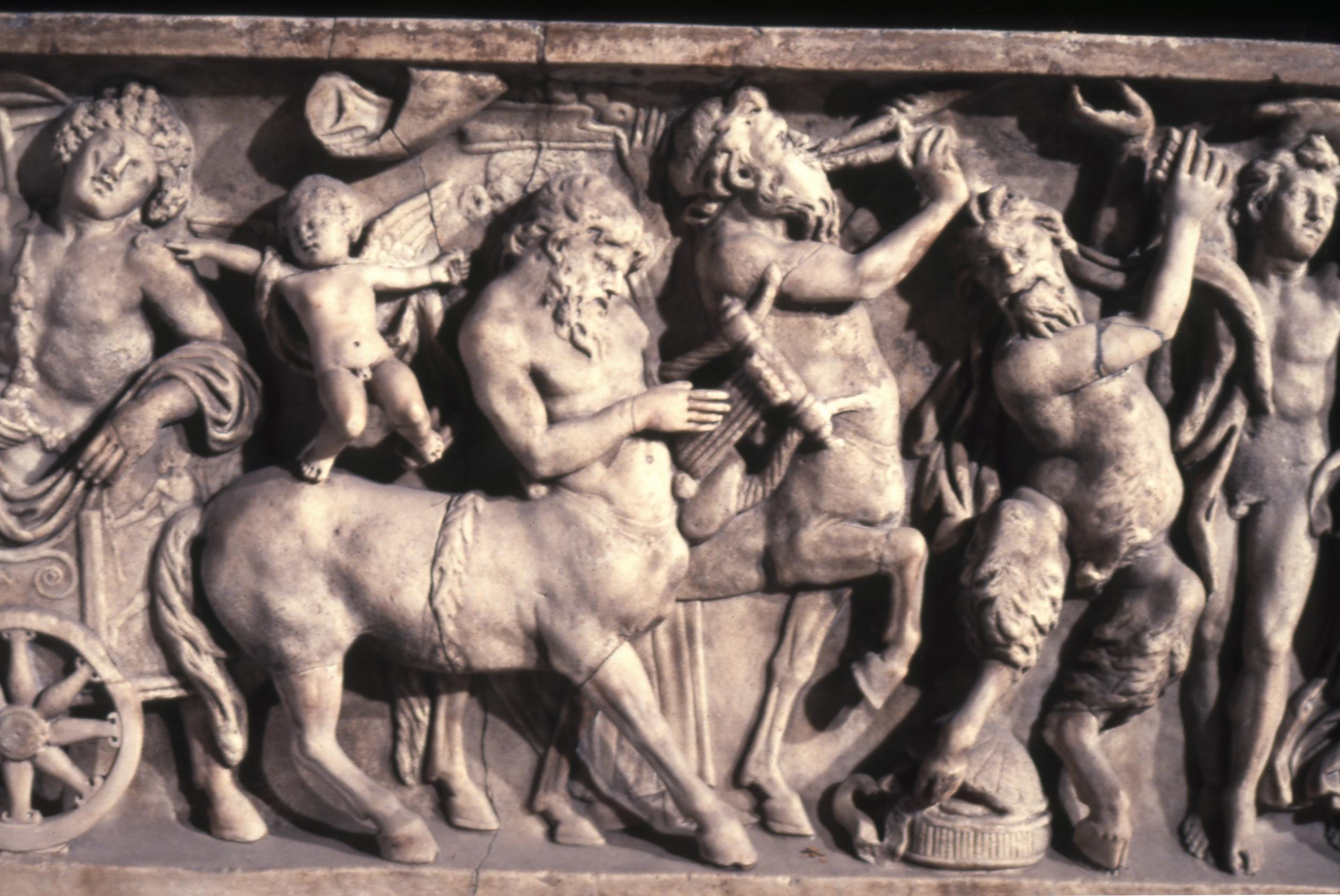
Front of a Roman marble sarcophagus: The marriage procession of Bacchus and Ariadne. © The Trustees of the British Museum. Shared under a Creative Commons Attribution-NonCommercial-ShareAlike 4.0 International (CC BY-NC-SA 4.0) licence.
“Look, I’m still not the kind of Priest to say things like ‘they’re putting demons in the robots,’ but the chainsaw-wielding black drones with eyeball horns are making it harder to argue my case,”
- Fr. Cassidy Stinson (@theHappyPriest), X
"Great nurse of Bacchus, to my prayer incline, Silenus honoured by the powers divine
And by mankind at the triennial feast, illustrious daimon, reverenced as the best ….
With all thy Satyrs on our incense shine, daimones wild formed, and bless the rites divine;
Come, rouse to sacred Joy thy pupil kin, and Brumal Nymphs with rites Lenaean bring,”
- Orphic Hymns 53 LIII: To Silenus, Satyrus and the Priestesses of Bacchus
Satyress, a California start-up, has a mission: “creating general purpose robots for dangerous jobs”. With that in mind, they recently announced the Threehalves, a “superhumanoid general purpose robot”, and it has caused quite a stir. “Threehalves” is a reference to its shape: it has the body and legs of a quadruped attached to a humanoid-shaped torso, arms and head.
It's a centaur.
But Threehalves is a centaur with a twist: Satyress have not scrimped on design. Threehalves comes in uniform matt black. It has piercing white eyes. And best of all (or worst of all, depending on what kind of robot aesthetics you prefer), it has horns - the backwards curved horns of a goat, which contain a second set of cameras. The memes have been memeing non-stop over this: “Hello. You have been rescued. Please stop screaming.”
Because yes, rescue is part of the deal. Threehalves is designed to be remote-steered by human workers - as the Satyress website says, to “give skilled workers superpowers - in jobs that are dangerous for humans now, or impossible, due to risk of injury or death, extreme heat, bitter cold, pitch darkness, or other inhumane conditions”. The chainsaw-wielding promo pic is showing what could be interpreted as a practical application - clearing firebreaks to prevent wildfires. Threehalves has no hands but can be fitted with a range of tools that its human operator can wield by proxy to do tasks like that. That is not to say that Satyress did not know what they were doing when they created the Threehalves and took its promo pictures. I don’t think it's reasonable to presume that anybody could accidentally create a tech reimagining of so many gothic folk horror tropes. If controversy and the resulting publicity it brings was the goal, it has worked: Satyress and the Threehalves have become mildly world famous overnight.
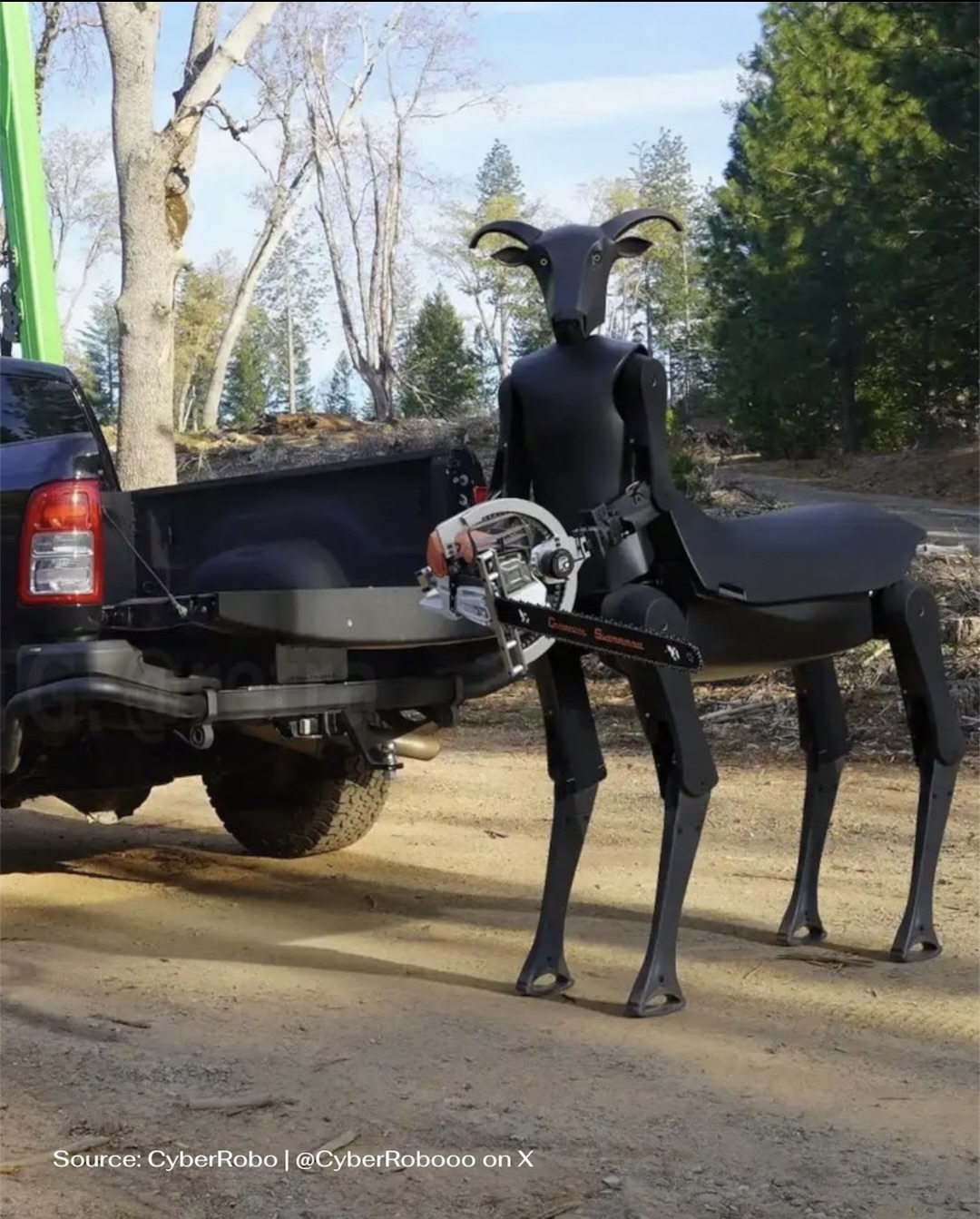
Threehalves Promotional Material, Satyress
I find the way that the tech industry recycles archetypal concepts endlessly fascinating: if you think of a mythical character or concept and google it, you’re highly likely to find that some tech company has named their product after it. But how much thought do they actually put into it? Archetypal signifiers have a way of cleaving to certain kinds of story, and I’m betting that a lot of the time, the archetype runs deeper than anybody consciously intended.
Consider the Threehalves, whose visual language reaches for two distinct archetypes at once:
-
The horns, the goat-head, the backwards-jointed knees and the company name say satyr - the goat-legged consorts of Dionysus. The infamous God of the Woodland, Pan, was depicted as having the same form.
-
The body-shape says centaur, a horse-bodied, human-torsoed creature. The most famous centaur is probably Chiron, the great teacher and healer of heroes, but most centaurs in Greek myth were not as civilised as Chiron - they were bestial, aggressive and wild. Like the satyrs, they are connected to Dionysus: centaurs pulled his chariot and together with satyrs and maenads, they made up his entourage, his thiasos.
The first, and easiest to spot, convergence of the archetype and the product is the combination of horror, disaster and - with reference to the wildfire use case - woodland. This is very squarely in Pan's domain. Pan is both the God of the woods and also where we get the word “Panic”: Pan is the God of nightmares, sudden, overwhelming terror and madness. Interestingly, this is exactly the term that the New York Post chose to describe the Threehalves’ reception after release: “His hellish chainsaw-wielding ‘centaur’ bot sparked panic online. He says it's here to help”. The thing that causes panic is “hellish”: Baphomet, the goat-headed, goat-legged deity whose modern iconography was described by Éliphas Lévi as linked to Pan, bears a distinct resemblance to the Christian Devil. Arguably this is the same deity we see represented as the Devil in the Rider-Waite tarot - goat-faced, goat-horned, goat-legged, surrounded by flames.
So far, so intentional. These are all relatively well-known cultural symbols these days. Whatever you think of Baphomet/ The Devil card/ Pan as a marketing ploy, we can probably agree that that's what it was.
The other archetypal creature evoked by the Threehalves is the centaur, and centaurs are familiar symbols in tech circles:
-
“Centaur” is sometimes used to describe tech, like the Threehalves, that only works as a collaboration between humans and robots: so the Threehalves is conceptually as well as literally a centaur.
-
“Centaur” is used to describe a strategic work model: this is probably its best-known usage in tech. It refers to humans and AI collaborating, each using their strengths to produce something better than they could achieve alone.
These examples centre around the concept of two different kinds of being - one organic, one created, working as one organism. Iron in the wood or wood in the iron, forming one tool and working on one task.
This duality of nature can result in something bestial and subhuman, which is exactly how the Greeks thought of centaurs. In modern robotics the centaur shape is well suited to working in rough or dangerous environments as it has a more stable centre of gravity than a biped. It also keeps the benefits of humanoid design - arms and sometimes hands suited to tool use, an elevated head on which cameras and other sensors can stay clear of hazards on the floor while being able to efficiently scan the environment. Run Robotics has recently launched an example of this kind of robot centaur. It is controlled by AI and designed to go where no human would or could work: oilfields, heavy industrial environments, radiation zones, mining. This is centaur yoked to labour, its intelligence used only for the execution of industrial service.
A few centaurs, however, managed to cultivate a different state of being. Chiron was a healer and a teacher - among his pupils were Jason of the Golden Fleece, Achilles and Hercules. We also have a modern example of centaur as aide to and supporter of the hero: NASA’s Centaur 2. This centaur-robot consists of a wheeled base and a “Robonaut” upper half. NASA developed it toward a spectrum of control modes, with supervised autonomy — the robot working independently on defined tasks, a human monitoring and able to intervene — as the intended destination. This is Chiron's structure, but inverted: the collaboration is real, but the centaur is now the student, and the human the mentor.
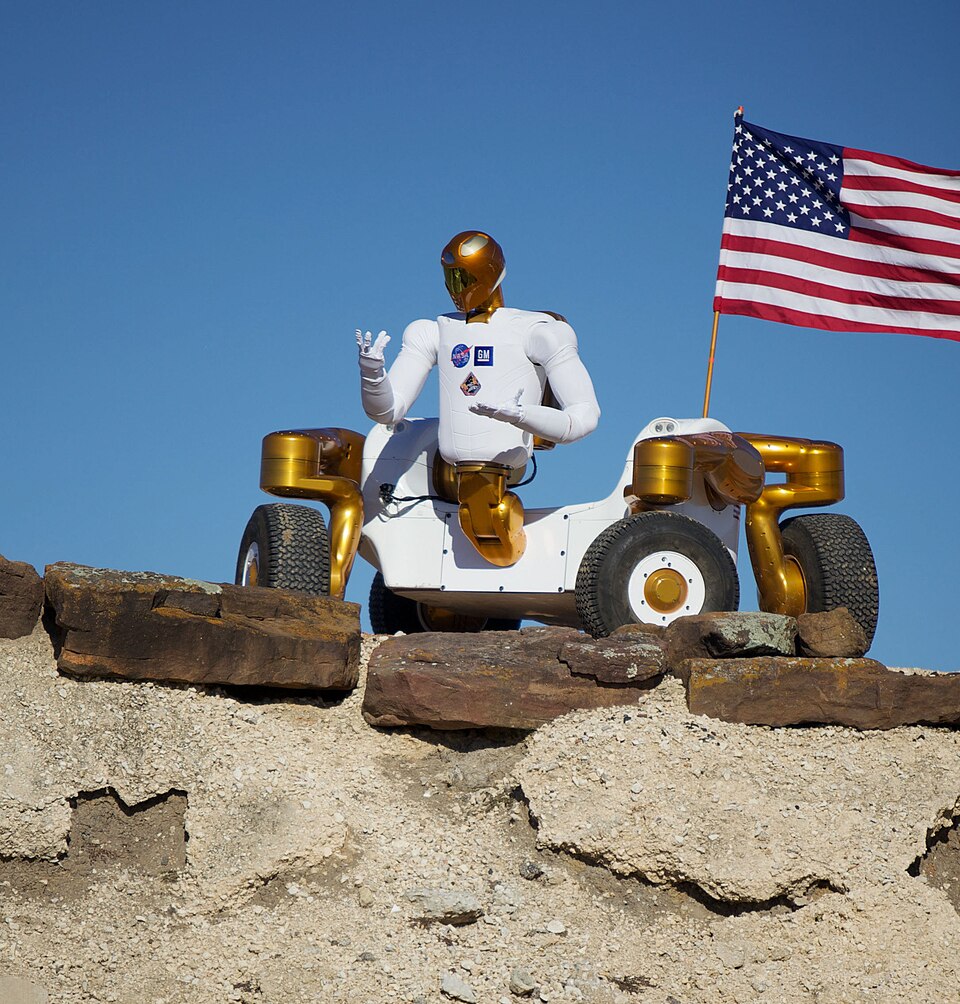
Centaur 2, Courtesy of Wikimedia Commons

But Threehalves is not only a centaur: it also carries the archetype of the satyr. Fr. Stinson’s “I’m not saying it but I’m saying it” description of the Threehalves, “they’re putting demons in the robots”, was actually spot on, in that sense. The Christian church did oversee a slow cultural shift that merged satyrs with the idea of the Christian devil to create what we now think of as a demon with horns, tail and goat feet. What they were to the Greeks was quite different. Satyrs were a type of daimon - the hymn quoted above addresses them as exactly that. Daimones were not anything like our modern concept of a demon.
To the Greeks, a daimon was an intermediary between one realm and another, a liminal being who could cross thresholds that others couldn’t. In Plato’s Symposium, Diotima describes them as a kind of intermediary between Gods and men, filling the gap between them.
Just as the Threehalves, whose website urges its customers to “become superhuman”, exists so that humans can virtually navigate terrain that would be impossible for them to survive in their human bodies.
Where the centaur’s man-half was dragged down into a subhuman state by its animal half, the satyr stayed split between the animal and human aspects of its nature. This inherent duality is what made it able to pass between realms, belonging in more than one place being a kind of transferable skill. This is why we see satyrs carved on sarcophagi as part of a wild procession, the thiasos. They have come to lead the soul of the newly dead to the revels in the afterlife. The soul might resist: the thiasos’ job would then be, quite literally, “hello. You have been rescued. Please stop screaming.”
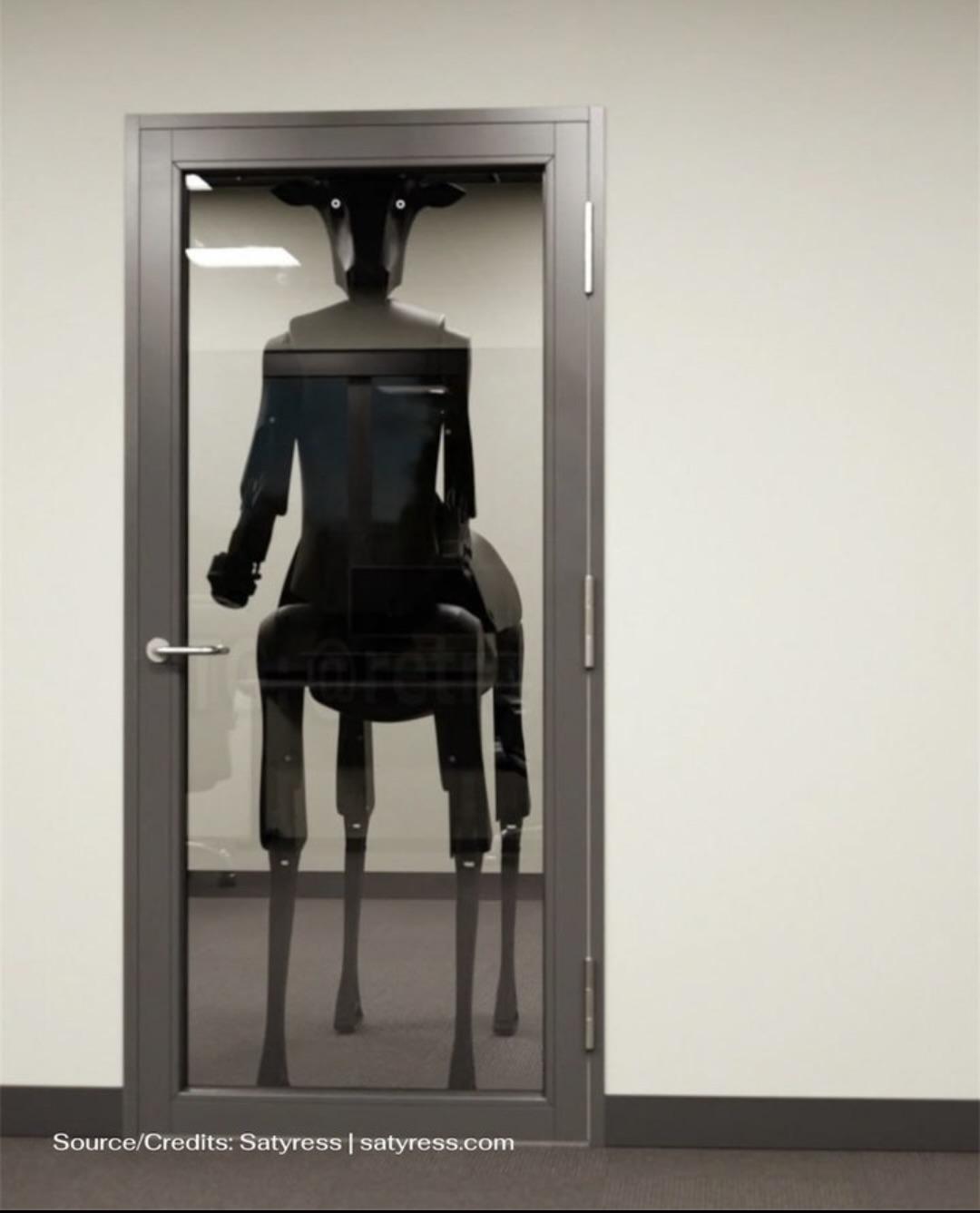
My favourite picture of the Threehalves isn’t the chainsaw shot. That’s arresting in a folk horror kind of way, but I prefer the shot of the robot taken through the glass door. This is the perfect image of a daimon. It is just on the other side of a barely-visible threshold. The discomfort comes from being seen anyway, and from knowing that if it wanted to reach you, the barrier could not stop it.