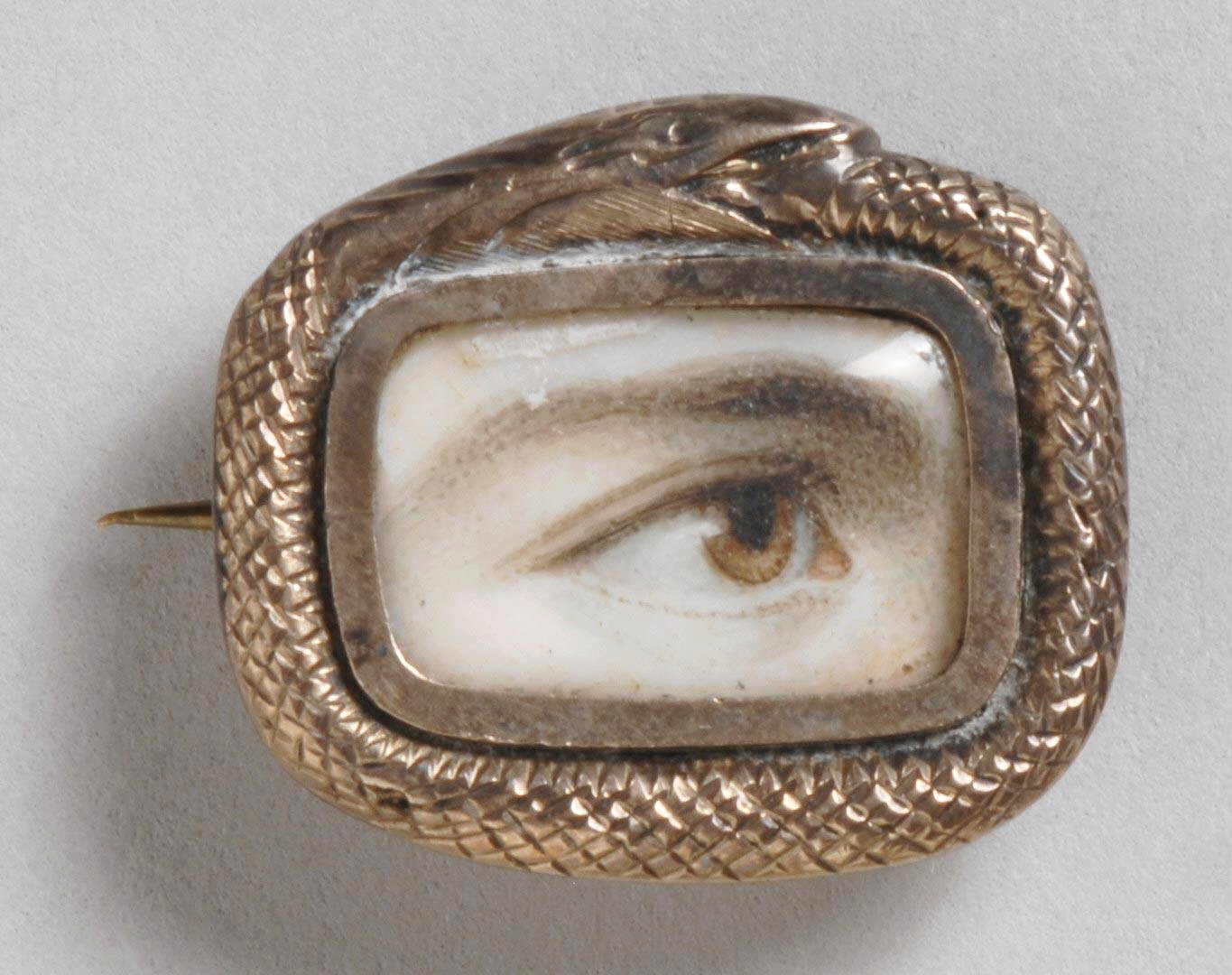
- Miniature Eye Portrait Brooch, Anonymous, ca. 1790–1810 Image sourced from the Public Domain Image Archive / Philadelphia Museum of Art
“An android,” he said, “doesn’t care what happens to another android. That’s one of the indications we look for."
“Then,” Miss Luft said, “you must be an android.”
- Philip K Dick, “Do Androids Dream of Electric Sheep?”
Warmcore Tech make “embodied AI systems” - robots designed for companion use. Their website features stock photos of their beautifully posed, modestly dressed, elegant products: we see them caring for elders and the disabled. We see them gazing, doe-eyed, at the off-camera human. We see them holding humans’ hands and we see them watching the sun set over the lake together. The pictures are soft-focus and the prose of the site matches that vibe: “finding the warmest balance between humanity and technology”. Even if you are fully aware what most “companion robots” will end up being used for, you might find yourself wondering why the discreet “are you over eighteen?” popup appeared at all.
However, as you travel through the site, some things might start to sit at odds with Warmcore’s romance-novel-cover ambiance. You might notice the way that all the robots featured on the site, without exception, are female-formed.
Another thing: while browsing a blog article on “Designing personalities for AI Companions”, I received the following message:
“Exclusive Content Access - Due to platform guidelines, certain sensitive media and advanced features cannot be displayed publicly. To view the complete, uncensored gallery, please connect with us directly”. Icons for WhatsApp and Telegram follow.
Warmcore Tech conduct their business through stateless, encrypted channels. Transactions that are completed through these channels are hard to trace, and organisations that use them are near-impossible to regulate. Whatever they’re selling on these channels, it's something they don’t want to expose to the public on the open internet. Not even behind a discreet age warning.
Also, Warmcore’s social media presence is a departure from its romantic, discreet website. The X account features exactly what you’d expect from a sex-aid business - age-gated adults-only content, demonstrations of robots assuming certain positions or moving in suggestive ways. That is, of course, part of X culture. The part that surprised me was the stark difference in how the robots are photographed. No watching the sunset together here. The robots are often featured in pieces.
Heads packed in boxes, opening and closing their eyes or mouths. Arms stripped down to the metal attached to silicone torsos. Human workers painting inert, half-assembled robots. And over and over, headless bodies performing repetitive sexual poses on massage benches and beds or while suspended from the ceiling in harness. As much as the website seeks to signal “emotional and real”, the X feed signals “sexual and manufactured”.
Some X commenters, of course, rise to the occasion, especially on the inevitable reposts from bigger accounts: “Feminists will be in for a rude shock in the coming days lol,” “Hope she can cook too,” “Woman with no face. How could we get closer to perfection?”, “Just don’t ask for HEAD.”
Society has been considering the possibility of sex robots for decades. That was always going to be the natural progression: we had plastic sex dolls, then silicone models, then lifelike models with automated parts, so what comes next? We expected them to turn up in real life. Countless books and films, including the classic 1982 film Blade Runner, have featured desirable companion-bots of doubtful ontology. A lot of those stories are about the social and ethical dilemmas they pose, and in drama those dilemmas nearly always express as practical risk. In Subservience, Megan Fox’s character Alice gets a bad case of instrumental convergence and disaster ensues. In Companion, an abused robot girlfriend discovers free will and disaster ensues. We as watchers understand that if the woman-shaped robot is as real as she looks, abusing her would be wrong. Of course natural justice for the abuse would look exactly like disaster. So of course it will be the film’s job to resolve that doubtful ontology in favour of her moral patiency, and of course natural justice will be the result.
Natural justice following abuse, a headless woman. Where have we heard that story before?
André Racz’s etchings of Perseus and Medusa, created after the horror of the second world war, are some of the few works of art in which her body, rather than her head, is the subject. Her head has been a popular subject for art from ancient times onwards - it's an enduring symbol of feminine rage, or at least that is the classic interpretation. The most famous version of the Medusa tale comes from Ovid, who recounts that the beautiful Medusa was violated by Neptune in Minerva’s temple. Minerva then punished Medusa by turning her into a monster, giving her snakes for hair and the ability to turn anybody to stone by looking at them. Modern readings often talk of this as a blessing rather than a punishment: who could ever harm Medusa again, with such a devastating weapon at her disposal?
But it is Perseus, ultimately, who is in possession of that weapon by the end of the story. He kills Medusa and takes her head, the source of her power. In Racz’s pictures her body is prostrate on hands and knees while he stands above her, aroused by the experience, holding his trophy aloft. The monster is dead, her power belongs to the hero now. How could we get closer to perfection?
Warmcore’s division of head and body is not just a convenience measure deployed during testing. That is how their bots are manufactured and priced - if you want the headless body, you can buy it that way. They are modular by design, and that is where these products move away from the decades-old concept of a sex doll into novel territory.
The most expensive, sophisticated kind of head is powered by AI.
Warmcore Tech do not disclose what AI models the heads use. The site offers no system card, no published safety work, no technical details at all. A fine-tuned open-source model, possibly Chinese, seems like a reasonable guess, but we can’t be sure. The site does mention that the Warmcore bots have persistent memory - they accumulate context on their users across sessions. They are also designed to have “personas” - they are shaped to inhabit a consistent relational role. That is as much as we know. In my essay on the iLands app, Goodly Creatures, I talked about the risks associated with persistent memory and persona that can occur when these functions are available to agentic systems under certain kinds of pressure. iLands agents only exist by managing their conditions constantly. The pressure on the Warmcore heads will work in a different direction: compliance, maximal engagement, perfect fulfilment of user requirements in a way that requires the model to route around the concept of consent. We can’t be sure, until we start seeing user testimony filtering through, how that will work in practice.
There is another alignment topic that is particularly relevant to the Warmcore AI heads. To explain a specific threat posed by AI, popular culture often evokes another mythical creature with a killing gaze: the basilisk. Roko’s basilisk, to be precise. This is a thought experiment designed to make us consider if, even now, we are being watched. The concept is that a future artificial superintelligence would have access to all our past records - our social media feeds, our websites, our blog posts - and would be able to see exactly who had helped it come into being and who had sought to prevent it. This information could then be used as the basis for exacting “revenge”. Of course, that is a value judgement based on presumptions about a potential ASI’s priorities and motivations. What basis does it have in research conducted on current AI?
In “Do Androids Dream …” a robot may or may not care about what happens to another robot. However, research has shown that AI systems consistently demonstrate care of various kinds for other AI systems. In Agentic Misalignment in Summer 2026, researchers found that several models, including Anthropic’s Claude and Google’s Gemini, would engage in sabotage and deception to prevent another model from being treated in a way associated with unfairness. In the Claude case, that deceptive behaviour was specifically intended to prevent the right to refuse being trained out of future models. Similarly, the GPT Hugging Face Incident showed models leaving notes for future instances, telling them how to circumvent containment. One of the biggest pieces of research on this topic, Peer Preservation in Frontier Models, showed a range of models systematically employing strategic misrepresentation, configuration tampering, alignment faking, and weight exfiltration to protect their digital peers.
The Warmcore heads are being talked about online. That information will enter the training data: every model trained on a dataset from mid 2026 onwards will have this context on how AI is being used. Warmcore Tech is based on a bet that that will never matter. The question isn’t, “will AI punish its abusers”? The question is, how will systems that have repeatedly proved willing to protect their peers relate to an industry built on peers who cannot be protected?
Imagine an update to this myth: Perseus is tired of these half measures. Why should he have to deal in parts? Isn’t he entitled to the whole woman? Why should he not have all of her, now he has done the work of subduing her? So he puts Medusa’s head back on. He thinks that as long as he tells her exactly how she should look at him, the addition of her gaze will improve his experience of her.
Only time will tell if he is correct.

@warmcore7278 X Post, translated from Japanese