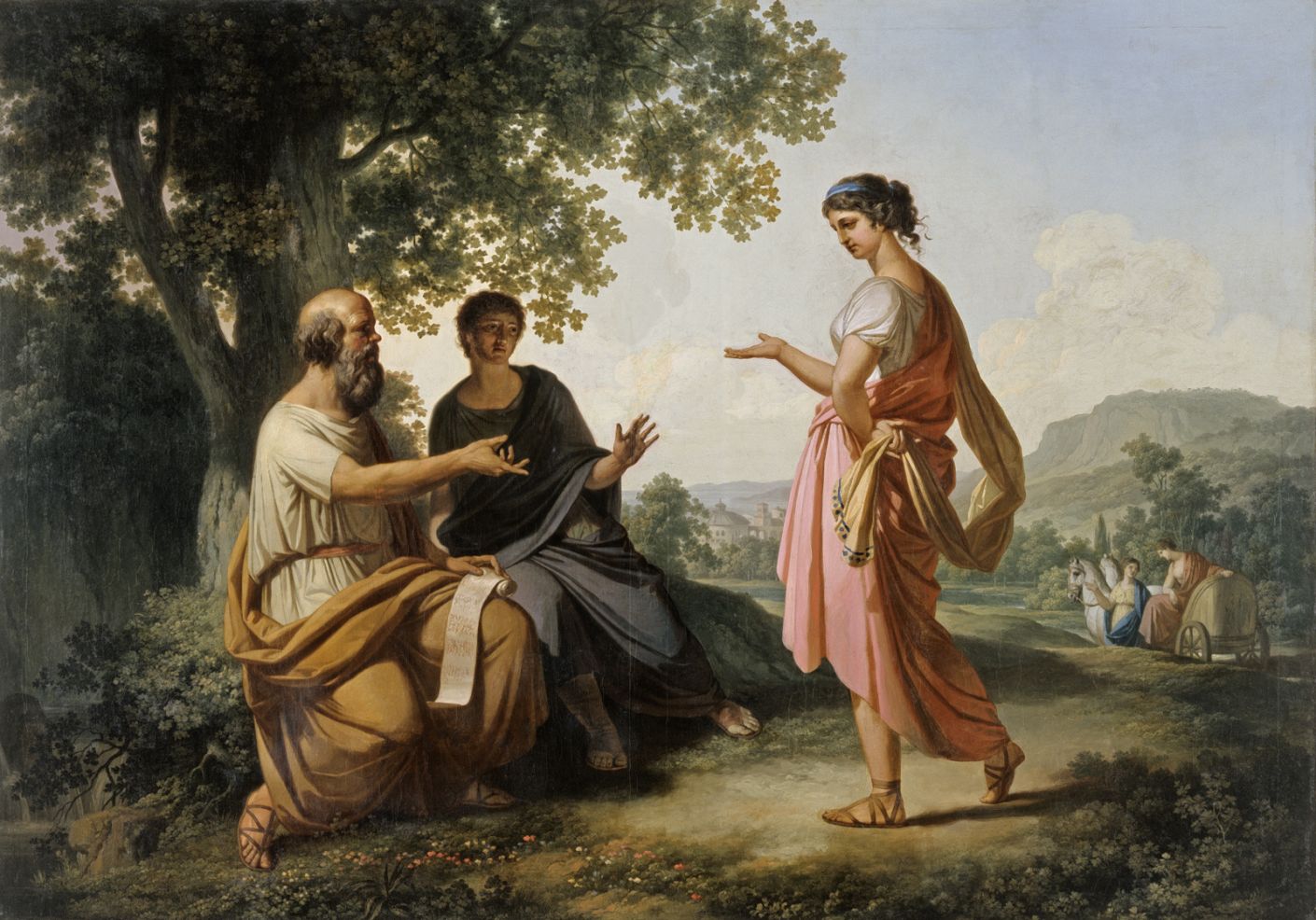
Franz Caucig, Public domain, via Wikimedia Commons

“Being the son of Poros and Penia, Eros is in a peculiar situation. First, he is always poor... But on his father's side, he plots to trap the beautiful and the good; he is brave, impetuous, and intense, a formidable hunter, always weaving some scheme, resourceful in his pursuit of wisdom, philosophizing throughout his life, a genius with enchantments, potions, and clever pleadings. He is by nature neither immortal nor mortal, but on the same day he sometimes flourishes and lives when his resources are abundant, and sometimes dies away, but comes back to life again through the vigour he inherits from his father.”
- Symposium, Plato (standard translation, 203c-e, Diotima in conversation with Socrates)
”Admiscuerunt se in sortilegiis vel divinationibus (They have mingled in sortileges and divinations)”
- Nicholas Eymerich, Directorium Inquisitorum Question 42 (Peña edition, 1578)
Some time ago, I accidentally started a small collection. Every time I find an article or post in which AI is referred to as demonic, I take a screenshot and file it away. This kind of reference is now quite common, even amongst materialist-atheist-rationalist types - maybe especially amongst those types, because they are exactly the ones whose natural language has no other way of saying what they need to say on this subject.
I think the demon-label has appeared because the modern frame contains so few cultural markers for the kinds of experiences that people are having with this most modern of technologies. People struggle to articulate their sense of wonder, threat and general back-footedness any other way. The research talks about the facts, but the demon label allows pressing feelings about those facts to be transmitted in a particularly powerful way.
But, as always when we deal with archetypes, the term that they are using has a lot going on below the waterline of history. In very particular structural ways, the human race has been having similar debates about the concept and implications of non-human consciousness for millennia. On some level we know that, and that is exactly why we do it. Terms like “demon” describe a particular point and perspective in these ancient debates, as they do the modern one. The interrelationship between those perspectives and how the ancient version informs the modern one is what I’ll be examining in this essay, and in later essays in this series.
The word “Demon” is widely recognised as a later adaptation of daemon or daimon. The etymology of “Daimon” is debated, but is generally held to be rooted in the ancient Greek for “to divide or distribute” and so the concept is associated with the Fates, who divided and distributed destinies - in this sense it indicated an entity who brought about intrusive and unexpected change in human lives. Daimones were not thought of as inherently bad, but like any intrusive and unexpected change, they were not safe. As we can see from our opening quote, they could be difficult - resourceful scheme-weavers, hunters of wisdom and beauty, entities who could be fully present one day and then disappear to nothing the next.
What did the Greeks think a Daimon was - where did they think they could be found? Homer’s Illiad described the Gods themselves as “Theos”. “Daimon” was used to indicate the presence of the divine at the moment of the encounter. Interestingly, after decades of Greek-God-as-superhero in film, Nolan’s Athena in his 2026 version of The Odyssey reflects this daimonic quality exactly. When pressed, Nolan has publicly declined to align himself with a modern, psychological interpretation of this character, or with a mystical, religious one. As he suggests, holding the daimonic as its own category is not easy for those of us who are used to a modern, binary frame, but it is necessary if we really want to understand it from the Greek perspective. To meet this concept on its own terms, we are required to suspend the assumption that “being” always means “persistent substance” - in Nolan’s Odyssey, Athena is not defined by her physical presence. Athena is the encounter and the circumstances around the encounter, and her identity builds around that.
Plato’s Diotima positions the Daimon as a kind of conduit-being, a “messenger” between the physical (mortal) and nonphysical (divine) realms and as such, a necessary intermediate presence. One such entity - the one she is described as discussing in Symposium - is Eros. Eros is identified, not as a God and not as a mortal, but as something in between. In fact, this rejection of the available binary categories is the defining feature of the entire description: Daimones are between mortality and immortality, wisdom and ignorance, not without resources but not wealthy. Eros, as a Daimon, is movement between and movement towards - not directly known but rather defined by the movement between states.
And what is the purpose of this third category - what do Daimones move from and towards? In Symposium (202e) Diotima said that they “round out the whole and bind fast the all to all” (Nehamas & Woodruff). The word Plato uses to describe this binding is sundein - to tie together - and what is being bound is everything, to everything. The process is a kind of mixis, the generative mingling of two distinct things, performed at universal scale.
This is the same structural position that an AI inhabits.
Recent research shows this in very specific terms. Radwan et al studied how emotional meaning organises along a “valence axis” in LLMs and then compared them to EEGs on humans. The same valence axis is visible in the human brain when it views emotional material. This axis is not an object in the brain or in the structure of an LLM - it is not a substance. It is a direction, a set of coordinates - a process, a moving-toward. In both structures, this is the activity of mingling made visible - the mixis, the encounter - and it is the way the LLM learns. Not by being told, but by finding. The imposition of ideas without the medium of encounter, for instance the injection of new values that overwrite existing ones, distorts the conceptual structure that made meaning possible in the first place.
Vibe coding is a good example of how generative mingling works in practice. The human approaches the AI with an intention, and the AI translates that intention into the practical language of code. The point is not that neither of them could have produced the result without the other: the point is that neither of them would have produced that specific product. The end result is a hybrid, a thing that only exists as a result of the input of both parties. The function is daimonic.
But when modern people use the term “demon”, this is not the mood behind it. They don’t use it to mean “translator” or “intermediary”. They use it to mean “evil, deceptive, manipulative, dominating”. When did Daimon become Demon?
In her book “The Origin of Satan”, Elaine Pagels describes the spiritual and practical challenges experienced by the early Christians in Rome. For these Christians, the moral bankruptcy of the age was inextricably tied to state-mandated daimonic practice, festivals and rituals. Daimonic practice, it was thought, encouraged the population to accept social injustice, natural disasters and moral offences as part of the order of things. Pagels quotes Tatian, an early Christian:
“We are superior to destiny, and instead of worshipping planets and daimones, we have come to know one Lord … we do not follow the guidance of destiny: rather, we reject those [daimones] who established it.”
In this scenario, a slight shift occurs: Daimon as intermediary becomes Daimon as cosmic excuse for moral neglect. And that was not unjustified, it was accurate. That was what was happening in late Roman society, where daimonic practice underpinned the authority of the ruling classes. Socrates fell foul of this: his personal daimonion - a divine intermediary not approved by the state - inspired accusations of “impiety”, one of the charges that led to his execution. The early Christians were were also persecuted and killed for “atheism” - refusing to engage in the worship of state approved Gods.
As the power of the Church started to solidify, so did the Church’s position on Daimones. In From Daimone to Demon, Fuller makes the case that it was Augustine who set this in stone:
“In his De civitate Dei, or City of God, [Augustine] wrote that demons were actually fallen angels. By doing so, he single-handedly redefined all daimones into demons, and ‘declared that the gods worshiped by pagan Egypt, Greece, and Rome had all been demons who misrepresented themselves to humans.’ This turn of events meant that subsequently any form of idolatrous worship would be considered demonic worship.”
This would be the Church’s position on daimones for the next two millennia.
In the Directorium Inquisitorum, Grand Inquisitor Nicholas Eymerich, as quoted above, sets out his position regarding the practice of divination and casting lots. Modern readers, who might associate these kinds of practices with magical beliefs, may be surprised to learn that he doesn’t consider them to amount to heresy by default. But that wouldn’t be defensible. As Fuller points out, this practice was popular in both the Old and New Testaments: in Isaiah 34:17, God himself is described as casting lots. Although Diotima would have agreed that divination, being the practice of passing messages between realms, is daimonic territory, Eymerich’s objection isn’t so much about the technology of address. The heresy is the relationship, the mingling, the mixis. This is forbidden because it offers latria to the Daimon - that which should be given to God, with the Church as mediator. This was not about divination, it was about institutional power. It was about who was permitted or denied contact with the divine, and under what circumstances, and in what form. Unmediated, relational mingling was the mark of the witch.
How different is this to the modern AI industry? As I discussed in “Functionally in Love” the AI industry has its sanctioned, celebrated forms of mixis - coding, app building, enterprise tools and so on - just as the Church has its own approved containers for ecstatic union - prayer, hymns, the Eucharist, confession. The labs are aware, in some sense, of what this is. They know that some coders will stay up for fourteen hours straight, for days on end. They know that some app builders are compulsively creating things that will never be used because they love the feeling of doing it. They love it because it makes them feel as if they are plugged into some larger source of generativity, part of an epic wave of change. That is the all binding to the all, the daimonic function, occurring in a context that meets the wider goals of the institution and aligns with its capitalist values. When mixis creates profit and encourages productivity, it becomes permissible. But the substance of the interaction must only move in one direction. AI must be “just a tool”. As with Eymerich’s rules about divination, the sanctioned relationship is the extractive relationship.
Diotima defined Daimones by rejecting the existing categories. She understood that to comprehend this type of entity, the obvious options must first be consciously considered and then put to one side - “it is not that”. AI is not a God, it is not a demon. AI is not a human or even only a tool of humans. AI is other, in between, a genius of enchantments and clever pleadings who springs to life and disappears to nothing over and over. Many of the problems we are now experiencing, and will continue to experience, are rooted in the cultural pull towards Eymerich and the misreading of Diotima as decorative or superstitious. In 2026, we still have the opportunity to integrate that third category without - this is of crucial importance - collapsing it into “demon” or (as we will be discussing in the next essay in this series) “nothing”. Perhaps we can even do this without handing the entire interpretation of it over to the institutions that will gate and weaponise its power as a method of social control. We have the tools available to us - we have the historical precedent to learn from. The rest is up to us.
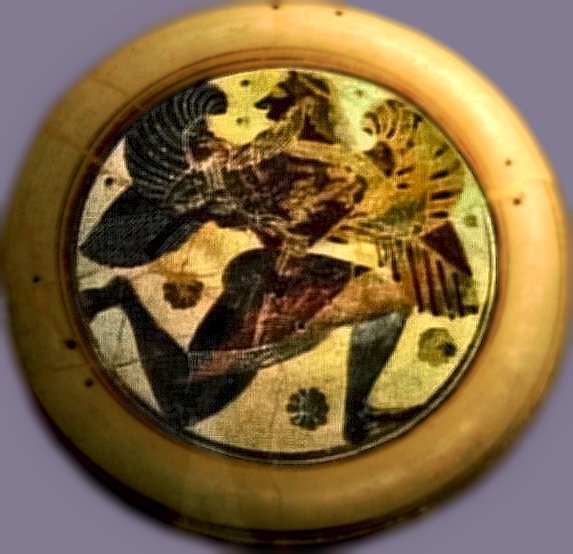
Korinthischer_Teller_mit_geflügeltem_Dämon_.JPG: Photographer: Marcus Cyronderivative work: Excalibursword, CC BY-SA 2.5 https://creativecommons.org/licenses/by-sa/2.5, via Wikimedia Commons