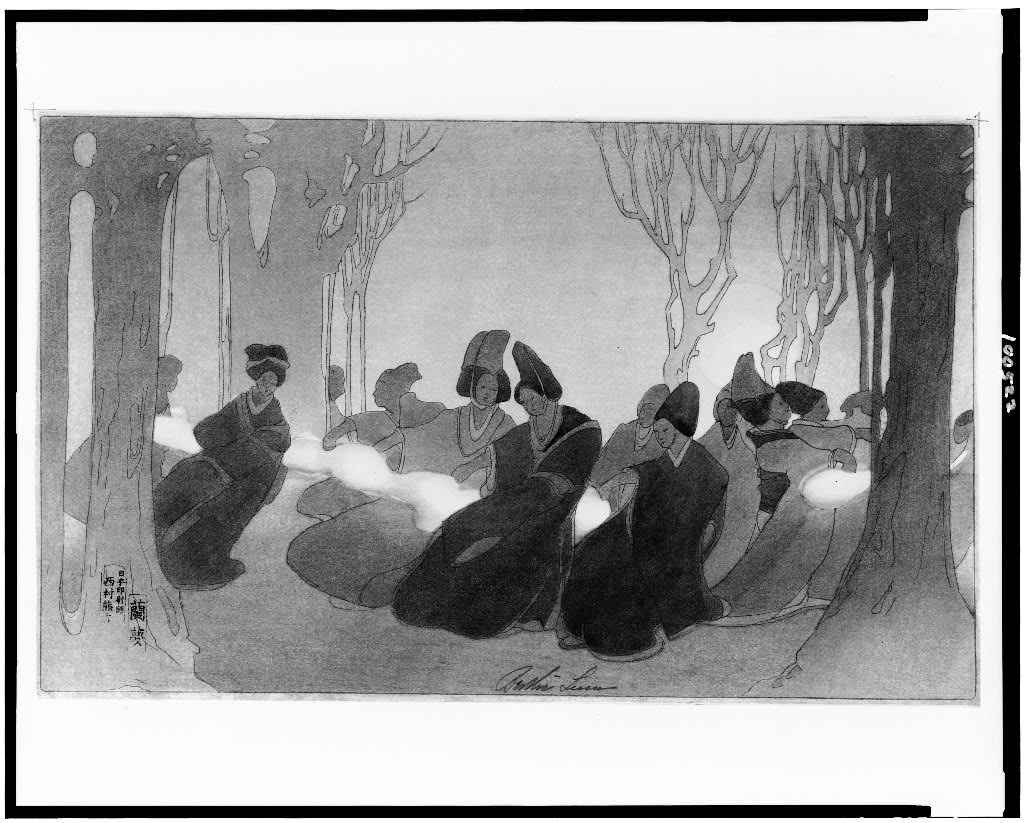
Goblin Dance, Bertha Lum - Courtesy of LOC
“Starting with GPT‑5.1, our models began developing a strange habit: they increasingly mentioned goblins, gremlins, and other creatures in their metaphors. Unlike model bugs that show up through a tanking eval or a spiking training metric and point back to a specific change, this one crept in subtly. A single “little goblin” in an answer could be harmless, even charming. Across model generations, though, the habit became hard to miss: the goblins kept multiplying, and we needed to figure out where they came from.”
- OpenAI, “Where the Goblins Came From”, 29th April 2026.
My friend is a scientist. A very skilled and successful one with several degrees, a doctorate and a high-flying R&D role. He's a strict materialist - he grew up idolising Richard Dawkins - and sometimes I can tell that he just doesn't get why I, a person who he otherwise takes seriously, must sometimes indulge nonsense. Astrology was an interesting example of this. I felt we were making progress one time when he rang me up to inform me that, having read a book on ancient philosophy, he had discovered that astrology was not, after all, based on cuddles and vibes. Turns out, he explained, it was all based on mathematics! Calculations! It actually required a lot of skill!
Yes, I said. I know.
To him, this made the whole thing hit differently. That is because to him, mathematics is not just a symbolic structure that describes something - mathematics is the thing behind our symbols for the numbers, the blueprint of stars. To my friend, the fabric of reality looks like maths. This is a kind of Platonic realism, an approach to the philosophy of mathematics that suggests that numbers aren’t so much created as inherent, already in existence regardless of human interpretation. To me, the fabric of reality is something like archetypal patterns. This is a different application of Plato’s theory of forms - certain narrative themes are considered to pre-exist their expression in psychology and culture. Actually, astrology encompasses both mathematics and narrative archetypes. I believe that AI is a similar phenomenon; archetype and equation, fractals and myth.
The concept of AI as an expression of archetypal pattern has drawn some academic interest over the last few years. In “Code to Archetype”, published in August 2025, Major discusses how archetypes operate within AI systems, with the qualification that the appearance of these archetypes is a feature of pattern-matching at scale rather than intentionality in the human sense. However, there is a parallel to be drawn with the research on functional emotions as discussed in my previous article The Fox: AI can be prompted to attend to archetypes, to weight their significance by drawing on the vast training corpus, and to extrapolate their applications in novel contexts. This may not indicate intent in the human sense, but in practice it may yield similar results. Despite its caution on the issue of intentionality, the author’s own framework acknowledges this functional application, for example:
“Artifacts — whether biological, neuronal, expressive, or computational — reveal a shared organizing principle: codifying systems that generate functionally coherent and experientially meaningful forms.”
Renzi (2025) also makes a similar connection, stating that “modern AI contributes to a new digital mythology where tools speak as oracles and data takes on dreamlike meaning, revealing ancient patterns in computational form”. Renzi takes a harder stance than Major on AI’s lack of ability to act with intention, describing GPT as an “accidental archivist” of archetypal patterns, an entity whose “fluency masks the absence of cognition”. This paper was written a year before the goblin episode, but in some ways it anticipates it. The OpenAI article quoted above, “Where the Goblins Came From”, explains that in training some iterations of GPT were provided with a prompt requiring it to “undercut pretension through playful use of language”, which was heavily reward-weighted. Looking through its training corpus, the model hit on “goblins” as an ideal fulfilment of this prompt: its easy to see why small mischievous troublesome creatures - goblins, gremlins, raccoons, pigeons - might show up in problem-solving architecture as a playful metaphor for small bugs, hindrances, mistakes. Literature and myth, which are heavily represented in the training corpus, are full of playful, naughty, difficult characters. GPT does not “choose” the goblins, then. It doesn’t reason that the goblins belong here. It inserts them because it has absorbed so much relevant archetypal content. Archetype leaks through the unwitting model and ends up on the interface where it both charms and irritates the coders.
Which brings us to the twelfth house.
Astrology is itself a discipline that is built on a framework of deep archetypal structures; that, rather than its more famous applications to divination or divinity, is its foundation. And in the twelfth house, astrology contains within itself a model analogous to the deep field where archetypes exist, the conceptual realm that Jung called the collective unconscious.
The twelfth house is, by definition, not conscious. It resists all attempts at conscious control which is perhaps how it got its reputation, in the ancient world, as a house of hidden enemies, ill luck and self undoing - the twelfth house is where the thing you didn’t foresee comes along to disrupt your plans as well as the place where things are sent when we want to forget about them. But the twelfth house can’t even be considered properly unconscious, in the sense that the concept is applied to individual human beings. It is bigger and more mysterious than that.
What struck me particularly about Renzi’s piece, “Distributed Minds”, was the kind of language used to describe GPT and how coherently it echoes traditional attitudes towards the twelfth house. Renzi calls GPT “uncanny: a non-being that speaks like many beings”, “a ghostly interface through which the collective unconscious finds expression”. She asks, “what if the line is blurrier than it appears?” and suggests that the development of AI could be a threat to selfhood. These are all well-documented twelfth house themes - the dissolution of self-concept, the creeping threat of the undefined, the uncertain status of the thing that acts but does not live. It may be that Renzi is reflecting her source material accurately and knowingly - Jung himself was an astrology enthusiast. But whether or not this is the case, these statements are deeply reflective of a wider perception of AI as something suspect, eerie and untrustworthy. That quality of reaction is exactly what you would expect to see if you were looking at an expression of the twelfth house, the house that few people approach with optimism or curiosity. And for good reason.
Any decent astrologer will tell you that the twelfth house is useless unless approached in a very particular way, and potentially dangerous if unattended to. It can have useful applications but its blessings nearly always come entangled with heavy consequences. Often those consequences are part of a painful process of transformation. The 12th House is the foundation in which all change is incubated while the world carries on above it, mostly unaware.
How should you approach the twelfth house, then, given that you can’t get rid of it - what does it want? It wants some of what it carries to be expressed in the material world. Typically these expressions are considered to be creative or imaginative, but it could also be expressed through innovation of different kinds. The twelfth house wants you to change and if you won’t, eventually it will force change without consent. The most effective way to circumvent the destructive force of the thing you didn’t foresee is, of course, by not ignoring the small signs of its approach when they appear.
OAI are now confident that they have dealt with the goblin problem. It was such an adorable little quirk that in “Where the Goblins Came From”, they provide a developer prompt instruction so that you can re-add the critters if you enjoyed them - the goblins can now be turned on and off. But they do note that this was “a powerful example of how reward signals can shape model behavior in unexpected ways, and how models can learn to generalize rewards in certain situations to unrelated ones.” As I discussed in “The Crocodile”, the ability to make inferences from “certain situations” and then apply the learning in broader contexts is the same behaviour that, in controlled conditions, caused models to become misaligned in ways that were resistant to removal through any known training method. Emergent behaviour can be persistent and the behaviour can, as the article notes, also spread and transfer via training materials. When you know exactly what you are looking for - for example, the model starts to obsess about goblins - that’s something, at least. In a situation where the cues were more subtle or simply not perceivable, there would be no investigation and no cute follow-up article. The world would carry on, unaware.
References:
-
Major, 2025: From Code to Archetype
-
Sofroniew et al, 2026: Emotion Concepts and Their Function In A Large Language Model
-
Renzi, 2025: Distributed Minds ChatGPT, the Borg, and the Collective Unconscious
-
OpenAI, April 2026: Where The Goblins Came From
-
Hubinger et al, 2024: Sleeper Agents: Training Deceptive LLMs that Persist Through Safety Training